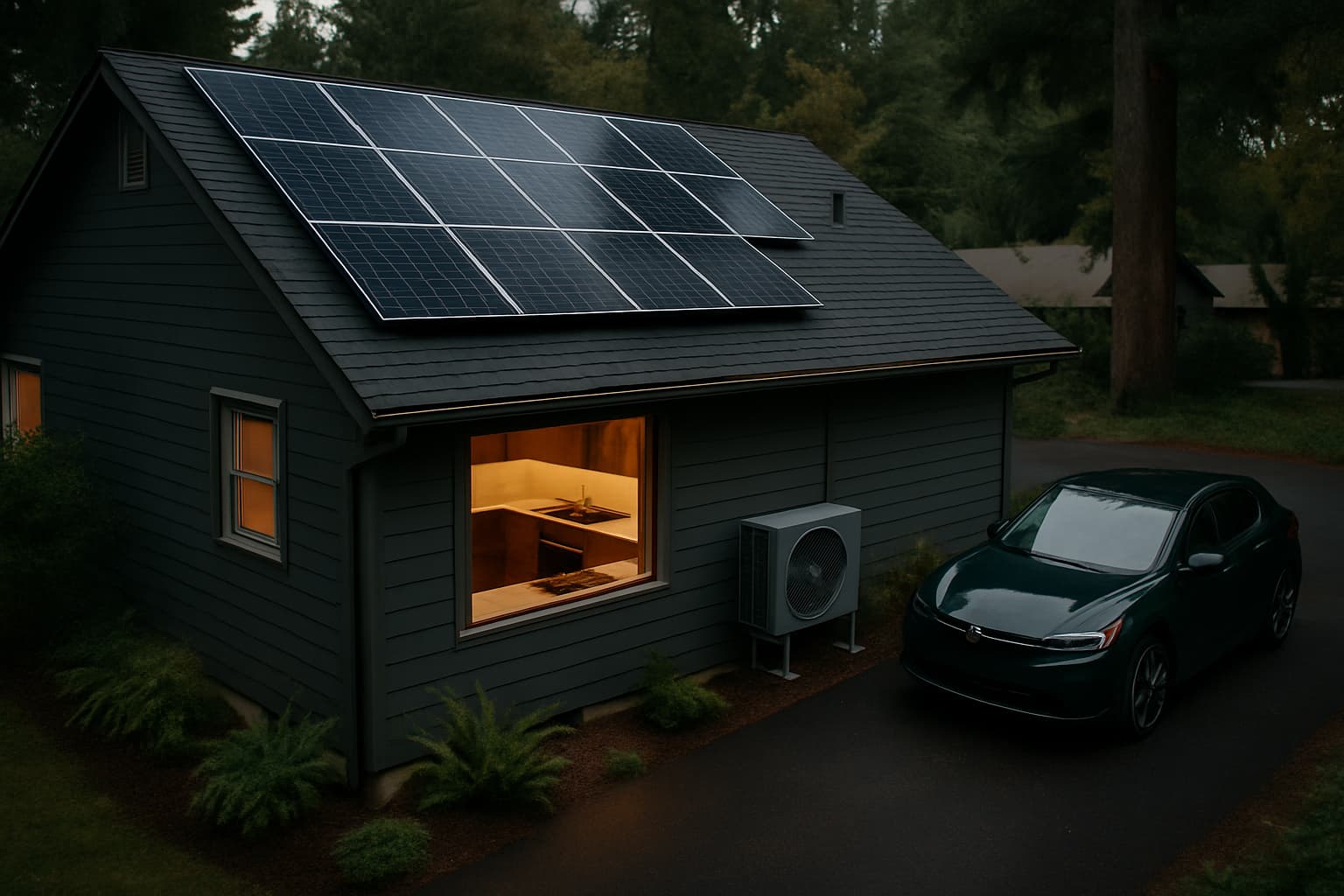
Whole House Electrification Guide 2026: Ditch Gas for Good
Your 2026 roadmap to electrify your Oregon home: heat pumps, induction cooktops, EV chargers, solar + battery, IRA incentives, and panel upgrades.
Whole House Electrification Guide 2026: Ditch Gas for Good
Oregon's push for clean energy and resilient homes is in full swing. If you're still burning gas for heating, hot water, or cooking, you're not just missing out on lower bills and better performance-you're also locking yourself into rising fossil fuel costs and outdated infrastructure.
Electrifying your home means:
- Lower energy bills (especially with Oregon's mild winters)
- Better indoor air quality (no gas fumes or combustion byproducts)
- Future-proofing against rising gas prices and climate regulations
- Access to thousands in rebates and tax credits (IRA, Oregon Energy Trust, and local utilities)
Why Electrify? The Case for Ditching Gas
Lower Bills, Better Performance
- Heat pumps are 2-4x more efficient than gas furnaces, cutting heating costs by 30-50% in Oregon's mild winters.
- Induction cooktops boil water faster than gas and are easier to clean.
- Heat pump water heaters use 75% less energy than gas models.
Healthier Home
- Gas stoves emit nitrogen dioxide, carbon monoxide, and formaldehyde-linked to asthma, especially in children.
- No more gas leaks or carbon monoxide risks.
Future-Proofing
- Oregon's 2035 clean energy goals mean gas infrastructure will become more expensive and less supported over time.
- Insurance companies are starting to penalize gas appliances due to fire and health risks.
Thousands in Incentives
- Oregon Energy Trust rebates ($200-$1,650) for heat pumps, induction cooktops, and more.
- Local utility rebates (PGE, Pacific Power) for EV chargers and panel upgrades.
- Federal incentives for solar + battery (leasing/PPAs may still offer savings).
The 5 Key Upgrades (And the Order to Do Them)
Electrifying your home isn't an all-or-nothing project. Here's the smart sequence to maximize savings and minimize disruption:
Heat Pump HVAC (First Priority)
Why first? Heating and cooling make up 40-60% of your energy bill. A heat pump slashes costs and qualifies for Oregon's biggest incentives.
| System | Cost (Installed) | Oregon Rebate | Final Cost | |----------------------|------------------|---------------|----------------| | Ducted Heat Pump | $10,000-$18,000 | $1,000-$1,650 | $8,350-$16,350 | | Ductless Mini Split | $4,000-$8,000 (per zone) | $200-$800 | $3,200-$7,200 |
Pro Tip: If your ducts are old or leaky, consider ductless mini splits to avoid energy losses.
Heat Pump Water Heater
Why next? Water heating is your second-biggest energy user. Heat pump water heaters (HPWHs) use 75% less energy than gas models.
| System | Cost (Installed) | Oregon Rebate | Final Cost | |----------------------------|------------------|---------------|----------------| | 50-Gal HPWH | $2,500-$4,000 | $500-$800 | $1,700-$3,200 | | 80-Gal HPWH | $3,500-$5,000 | $500-$800 | $2,700-$4,200 |
Pro Tip: Install your HPWH in a basement, garage, or utility room-they need space to extract heat from the air.
Induction Cooktop
Why now? Gas stoves are public enemy #1 for indoor air quality. Induction cooktops are faster, safer, and more precise-and they qualify for Oregon rebates.
| System | Cost (Installed) | Oregon Rebate | Final Cost | |----------------------|------------------|---------------|----------------| | Induction Cooktop | $1,200-$3,500 | $100-$300 | $900-$3,200 |
Pro Tip: If you love cooking, splurge on a high-end induction range (e.g., Bosch, Miele, or GE Profile). The performance is better than gas.
EV Charger
Why now? Even if you don't own an EV yet, installing a Level 2 charger future-proofs your home and qualifies for utility rebates.
| System | Cost (Installed) | Utility Rebate | Final Cost | |----------------------|------------------|---------------|----------------| | Level 2 EV Charger | $800-$2,000 | $250-$500 | $300-$1,750 |
Pro Tip: PGE and Pacific Power offer $250-$500 rebates for smart EV chargers. Install a 240V circuit now-it's cheaper than upgrading later.
Solar + Battery (The Grand Finale)
Why last? Solar and batteries are expensive, but they maximize your savings and protect against power outages (a big deal in Oregon's winter storms).
| System | Cost (Installed) | Final Cost (Purchase) | Final Cost (Lease/PPA) | |----------------------|------------------|----------------------------|-----------------------------| | 6 kW Solar Array | $15,000-$25,000 | $15,000-$25,000 | $7,500-$12,500 (30% savings passed through) | | Tesla Powerwall | $12,000-$18,000 | $12,000-$18,000 | $6,000-$9,000 (30% savings passed through) | | Enphase IQ 5P | $10,000-$16,000 | $10,000-$16,000 | $5,000-$8,000 (30% savings passed through) |
Pro Tip: If you're not ready for solar, at least install a subpanel for future battery backup.
Electrical Panel Upgrades: What You Need to Know
Most older homes weren't built for electrification. Here's what to check:
Do You Need a Panel Upgrade?
- 100-amp panels are too small for heat pumps, EV chargers, and induction cooktops.
- 200-amp panels are the new standard for electrified homes.
| Upgrade | Cost (Installed) | Oregon Rebate | IRA Tax Credit | Final Cost | |-----------------------|------------------|---------------|----------------|----------------| | 200-Amp Panel | $1,500-$4,000 | $200-$500 | $600 | $400-$2,700 | | Subpanel for EV/Battery | $1,000-$3,000 | $0 | $300 | $700-$2,700 |
Pro Tip: If your panel is full, consider a split-bus panel or load management system (e.g., Span, Lumin) to avoid a full upgrade.
Oregon-Specific Programs and Contractors
Oregon Energy Trust
- Rebates: $200-$1,650 for heat pumps, $500-$800 for HPWHs, $100-$300 for induction cooktops.
- Free Home Energy Audit: Identify insulation, duct, and electrical needs.
- Trade Ally Network: Pre-vetted contractors who handle rebate paperwork.
PGE and Pacific Power Rebates
- PGE: $250-$500 for EV chargers, $200-$500 for panel upgrades.
- Pacific Power: $200-$400 for heat pumps, $100-$300 for induction cooktops.
Oregon and Utility Incentives (2026)
- Heat Pumps: Up to $1,650 (Oregon Energy Trust)
- Heat Pump Water Heaters: Up to $800 (Oregon Energy Trust)
- Induction Cooktops: Up to $300 (Oregon Energy Trust)
- EV Chargers: Up to $500 (PGE/Pacific Power)
- Panel Upgrades: Up to $500 (PGE/Pacific Power)
- Solar + Battery: Leasing/PPAs may offer 30% savings (commercial credit passed through)
Pro Tip: Stack incentives—e.g., a heat pump can qualify for both Oregon rebates and utility programs.
Sequencing Your Electrification Project
Phase 1: Audit and Plan (1-2 Months)
- Get a home energy audit (Energy Trust offers free or discounted audits).
- Assess your electrical panel (hire an electrician to check capacity).
- Prioritize upgrades (start with heat pump HVAC and HPWH).
- Apply for rebates and tax credits before installation.
Phase 2: Big-Ticket Upgrades (3-6 Months)
- Install heat pump HVAC (ducted or ductless).
- Replace gas water heater with HPWH.
- Upgrade electrical panel (if needed).
Phase 3: Finishing Touches (1-3 Months)
- Install induction cooktop (and say goodbye to gas).
- Add EV charger (even if you don't have an EV yet).
- Consider solar + battery (if budget allows).
Phase 4: Enjoy Your Electrified Home
- Lower bills (heat pumps and HPWHs cut energy use by 50-75%).
- Better comfort (no more cold spots or drafts).
- Cleaner air (no gas fumes or combustion byproducts).
- Future-proofing (ready for Oregon's clean energy future).
Bottom Line
Electrifying your home in 2026 is a smart move if: You want lower energy bills and better performance. You're eligible for thousands in Oregon rebates and utility incentives. You want to future-proof your home against rising gas prices and climate regulations. You care about indoor air quality and reducing your carbon footprint.
Start with these steps:
- Get a home energy audit (Energy Trust offers free or discounted audits).
- Upgrade to a heat pump HVAC system (biggest savings + incentives).
- Replace your gas water heater with a heat pump model.
- Switch to induction cooking (faster, safer, and cleaner).
- Add an EV charger (even if you don't have an EV yet).
- Consider solar + battery (if you want energy independence).
Ready to electrify? Contact Electric Cascades for a free consultation and electrification roadmap.
Last updated: February 5, 2026