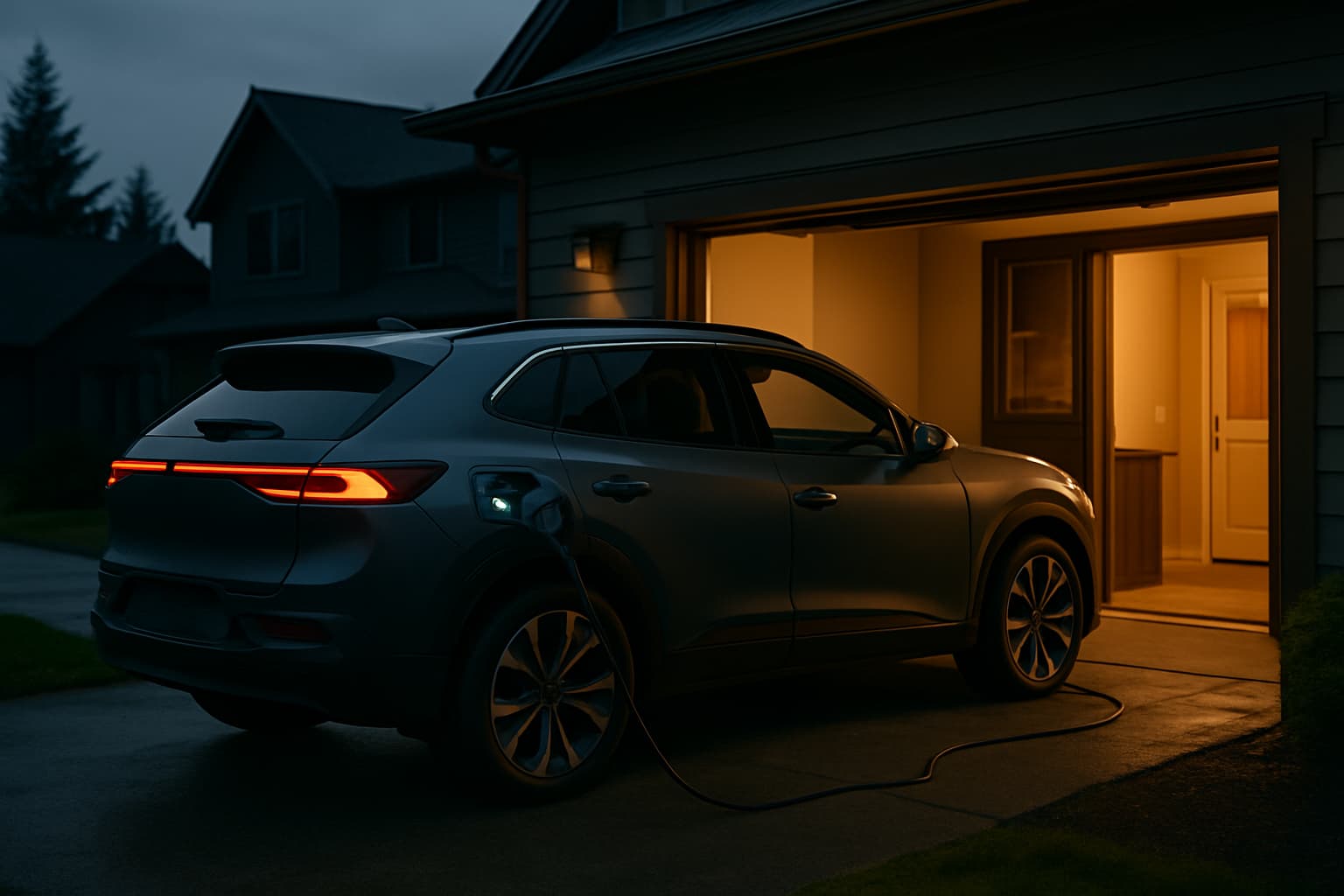
Vehicle-to-Home (V2H) Power Backup: Complete Guide
Learn how Vehicle-to-Home (V2H) technology lets you use your EV as a home backup generator. Compare Ford, Hyundai, Kia, and bidirectional charging setups for 2026.
Vehicle-to-Home (V2H) Power Backup: Complete Guide
Power outages are a fact of life in the Pacific Northwest—whether from winter storms, wildfire smoke, or grid instability. What if your electric vehicle (EV) could double as a backup power source for your home?
Vehicle-to-Home (V2H) technology lets you use your EV’s battery to power your home during outages, reduce energy costs, and even sell power back to the grid. It’s like having a backup generator, but without the noise, fuel, or emissions.
How V2H Works
- Bidirectional Charging: Your EV’s battery sends power back to your home through a bidirectional charger.
- Power Management: A home energy management system (HEMS) distributes power to essential appliances (fridge, lights, heating, etc.).
- Grid Interaction: Some systems allow you to sell excess power back to the grid or use it to reduce energy costs.
V2H vs. V2L (Vehicle-to-Load)
- V2H: Powers your entire home or selected circuits during an outage.
- V2L: Powers individual devices (e.g., phones, laptops, or small appliances) via a standard outlet.
V2H is more powerful and requires professional installation, while V2L is portable and plug-and-play.
Which EVs Support V2H in 2026?
Not all EVs support V2H, but the list is growing. Here are the top V2H-capable vehicles in 2026:
Ford F-150 Lightning (Intelligent Backup Power)
| Feature | Details | |------------------------|-------------------------------------------------------------------------| | V2H Capable? | Yes (Intelligent Backup Power) | | Battery Capacity | 98 kWh (Standard Range) / 131 kWh (Extended Range) | | Max Power Output | 9.6 kW | | Home Integration | Works with Ford Charge Station Pro and Home Integration System | | Cost | ~$70,000 (Extended Range) |
How It Works:
- The Ford Charge Station Pro (included with Extended Range models) enables bidirectional charging.
- The Home Integration System (sold separately) manages power distribution to your home.
- Can power your home for up to 3 days (depending on battery size and usage).
Hyundai Ioniq 5 / Kia EV6 (Vehicle-to-Load + V2H Ready)
| Feature | Details | |------------------------|-------------------------------------------------------------------------| | V2H Capable? | Yes (with aftermarket adapter) | | Battery Capacity | 58 kWh (Standard Range) / 77.4 kWh (Long Range) | | Max Power Output | 3.6 kW (V2L) / 10.5 kW (V2H with adapter) | | Home Integration | Requires Wallbox Quasar 2 or Fermata Energy FE-15 | | Cost | ~$45,000 (Ioniq 5) / ~$48,000 (EV6) |
How It Works:
- V2L is standard (use a household outlet to power devices).
- V2H requires an aftermarket adapter (e.g., Wallbox Quasar 2 or Fermata Energy FE-15).
- Can power your home for up to 24 hours (depending on battery size and usage).
Nissan Leaf (V2H with CHAdeMO Adapter)
| Feature | Details | |------------------------|-------------------------------------------------------------------------| | V2H Capable? | Yes (with CHAdeMO adapter) | | Battery Capacity | 40 kWh (Standard Range) / 62 kWh (Plus) | | Max Power Output | 6 kW | | Home Integration | Requires Wallbox Quasar or Fermata Energy FE-15 | | Cost | ~$30,000 (Leaf S) |
How It Works:
- The Nissan Leaf was one of the first EVs to support V2H, but it requires a CHAdeMO adapter (becoming less common).
- Can power your home for up to 12 hours (depending on battery size and usage).
Tesla Cybertruck (V2H Ready, Details TBA)
| Feature | Details | |------------------------|-------------------------------------------------------------------------| | V2H Capable? | Expected in 2026 (details not yet confirmed) | | Battery Capacity | ~123 kWh (Est.) | | Max Power Output | TBA | | Home Integration | Expected to work with Tesla Powerwall or third-party adapters | | Cost | ~$60,000 (Est.) |
How It Works:
- Tesla has teased V2H capabilities for the Cybertruck, but details are still pending.
- Likely to require a Tesla Powerwall or third-party adapter for full V2H functionality.
How to Set Up V2H: Step-by-Step
Check Your EV’s Compatibility
- Confirm your EV supports bidirectional charging (see the list above).
- If your EV only supports V2L, you can still power individual devices but not your entire home.
Install a Bidirectional Charger
- Ford F-150 Lightning: Use the Ford Charge Station Pro (included with Extended Range models).
- Hyundai/Kia/Nissan: Use the Wallbox Quasar 2 or Fermata Energy FE-15.
- Tesla Cybertruck: Wait for Tesla’s official V2H solution (expected in 2026).
Install a Home Energy Management System (HEMS)
- A HEMS (e.g., Ford Home Integration System, Span Panel, or Tesla Powerwall) distributes power to your home.
- Works with your electrical panel to prioritize essential circuits (fridge, lights, heating, etc.).
Get a Professional Installation
- Hire a licensed electrician to install the bidirectional charger and HEMS.
- Permits may be required (check local regulations in Oregon).
Test Your System
- Simulate an outage to ensure your V2H system works as expected.
- Monitor power usage to avoid draining your EV’s battery completely.
Costs of V2H in 2026
| Component | Estimated Cost (2026) | Notes | |-------------------------|-----------------------|---------------------------------------------| | Bidirectional Charger | $3,000 - $6,000 | Ford Charge Station Pro, Wallbox Quasar 2 | | Home Energy Management System (HEMS) | $2,000 - $5,000 | Ford Home Integration System, Span Panel | | Electrical Upgrades | $1,000 - $3,000 | Panel upgrades, wiring, permits | | Installation | $1,500 - $3,000 | Licensed electrician | | Total | $7,500 - $17,000 | Varies by setup and incentives |
Oregon-Specific Incentives for V2H
- Federal Tax Credit: The 30% federal tax credit for V2H equipment expired in 2025. However, state and local incentives (e.g., Oregon Solar + Storage Rebate) may still apply.
- Oregon Solar + Storage Rebate: Up to $5,000 for energy storage systems (including V2H). Note: The 30% federal tax credit expired in 2025.
- Local Utility Rebates:
- Portland General Electric (PGE): Up to $1,000 for V2H equipment.
- Pacific Power: Up to $1,500 for V2H equipment.
Pros and Cons of V2H
Pros
Backup Power During Outages: Keep your fridge, lights, and heating running during storms. Reduce Energy Costs: Use your EV’s battery to power your home during peak demand hours (when electricity is most expensive). Sell Power Back to the Grid: Some utilities allow you to sell excess power from your EV’s battery. No Fuel or Noise: Unlike gas generators, V2H is silent and emission-free. Increase Home Value: V2H systems can make your home more attractive to buyers.
Cons
High Upfront Cost: V2H systems can cost $7,500 - $17,000 to install. Limited EV Compatibility: Not all EVs support V2H (yet). Battery Degradation: Frequent V2H use may reduce your EV’s battery lifespan. Complex Installation: Requires a licensed electrician and may need permits. Power Limitations: Your EV’s battery may not power your entire home for extended outages.
V2H vs. Home Battery Backup (e.g., Tesla Powerwall)
| Feature | V2H (Vehicle-to-Home) | Home Battery Backup (e.g., Tesla Powerwall) | |------------------------|-----------------------------------------------|---------------------------------------------| | Power Source | Your EV’s battery | Dedicated home battery | | Capacity | 50-130 kWh (depends on EV) | 13.5 kWh (Powerwall) | | Cost | $7,500 - $17,000 | $10,000 - $20,000 | | Installation | Complex (requires bidirectional charger) | Moderate (requires professional install) | | Flexibility | Portable (can take your EV anywhere) | Fixed (stays at home) | | Best For | EV owners who want backup power | Homeowners who want a dedicated backup |
Which Is Right for You?
- Choose V2H if: You already own (or plan to buy) a V2H-capable EV and want a portable backup power solution.
- Choose a Home Battery if: You want a dedicated, always-available backup and don’t want to rely on your EV.
Bottom Line
- Vehicle-to-Home (V2H) technology lets you use your EV as a backup power source for your home during outages or peak demand hours.
- Top V2H-capable EVs in 2026: Ford F-150 Lightning, Hyundai Ioniq 5, Kia EV6, Nissan Leaf, and (soon) Tesla Cybertruck.
- Costs: $7,500 - $17,000 for equipment and installation, but Oregon incentives (e.g., Solar + Storage Rebate) can reduce this by thousands.
- Pros: Backup power, reduced energy costs, no fuel or noise.
- Cons: High upfront cost, limited EV compatibility, battery degradation.
If you live in Oregon and want reliable backup power without a gas generator, V2H is a smart, future-proof investment. Start by checking if your EV supports V2H, then explore incentives and installation options!