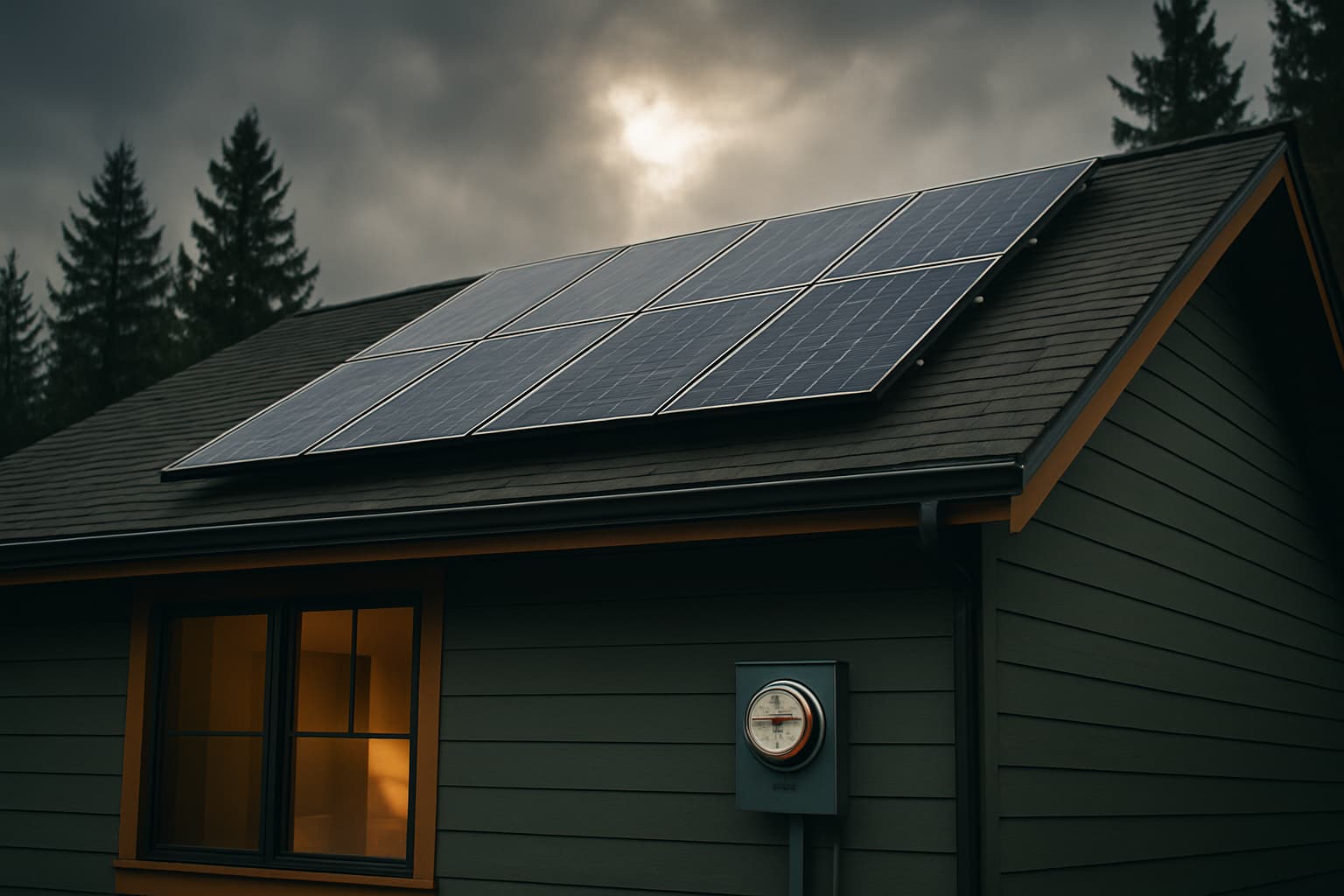
Are Solar Panels Worth It in the Pacific Northwest?
The honest truth about solar in Oregon and Washington. We break down the numbers, bust the myths, and show you when solar makes sense.
"But it rains all the time here!"
If you live in Oregon or Washington, you've probably heard this a hundred times when mentioning solar. It's the #1 objection—and it's mostly wrong.
Let's look at the real numbers and figure out if solar makes sense for your home.
The Myth vs. Reality
The myth: The Pacific Northwest is too cloudy for solar.
The reality: Germany gets less sunshine than Portland and leads the world in solar installations. Seattle gets more annual sunlight than Houston gets annual rain days. Solar works fine here.
Actual Solar Production Numbers
| Location | Peak Sun Hours/Day | Annual Production (6kW system) | |----------|-------------------|-------------------------------| | Portland, OR | 4.2 | 7,500 kWh | | Seattle, WA | 3.8 | 6,800 kWh | | Los Angeles, CA | 5.6 | 10,000 kWh | | Munich, Germany | 3.0 | 5,400 kWh |
Yes, you'll produce less than Arizona. But you'll still produce plenty—and PNW electricity rates are low enough that payback periods are similar.
The Real Math
Let's run actual numbers for a typical Portland home:
Your situation:
- Monthly electric bill: $150
- Annual usage: ~12,000 kWh
- Current rate: ~$0.12/kWh
A right-sized solar system:
- System size: 8 kW
- Annual production: ~10,000 kWh
- System cost: $24,000
After incentives:
- Federal tax credit: $0 (expired end of 2025 — but available via lease/PPA, see below)
- Oregon Energy Trust rebate: -$5,000
- Net cost: ~$19,000 (purchased outright)
If you lease or sign a PPA instead: The solar company can still claim up to 30% under Section 48E (through 2027) and pass the savings to you — often as $0-down with lower monthly payments than your current electric bill.
Payback calculation (purchased system):
- Annual savings: ~$1,200
- Simple payback: ~16 years
- Panel warranty: 25 years
- 9+ years of free electricity after payback
Payback with lease/PPA: Many homeowners see immediate savings on day one since the monthly lease payment is often less than their old electric bill.
The Real ROI
Even without the federal credit, a purchased system still delivers positive ROI over the panel's 25-year warranty. And if you go the lease/PPA route, you can start saving from month one with no upfront cost.
When Solar Makes the MOST Sense
Solar is an especially good investment if:
You Have High Electric Bills
If you're paying $200+/month, your payback period gets much shorter. EV owners and people with electric heat often see the fastest returns.
You Plan to Stay Put
Solar pays off over time. If you're staying 7+ years, you'll likely break even and then profit. (Though solar also increases home resale value.)
You Have Good Roof Orientation
South-facing roofs are ideal, but west-facing works nearly as well in the PNW. Even east-facing can pencil out. The only dealbreaker is heavy shade.
Your Roof is in Good Shape
If you need a new roof in the next 5-10 years, do that first. Re-roofing under panels is expensive.
You Value Energy Independence
This is harder to quantify, but many people value producing their own power—especially with increasing grid instability and wildfires.
When Solar Might NOT Make Sense
Be cautious if:
- You're renting (look into community solar instead)
- Your roof is heavily shaded by trees
- You plan to move in less than 5 years
- Your electric bills are already very low (under $75/month)
- Your roof needs replacement soon
The PNW Solar Advantage
Here's something most people don't realize: solar panels work better in cooler temperatures.
Panels are rated at 77°F (25°C). For every degree above that, efficiency drops. In Arizona summers, panels can lose 10-15% efficiency. In Oregon? Your panels run at peak efficiency almost all summer.
Plus, our long summer days are a huge advantage. In June, Portland gets nearly 16 hours of daylight. That's a lot of production time.
What About Cloudy Days?
Panels still produce on cloudy days—just less. A heavily overcast day might produce 10-25% of peak output. Light clouds? 50-70%.
This is where net metering saves you:
- Sunny days: Bank excess credits with the utility
- Cloudy days: Use your banked credits
- Result: Your annual production covers your annual usage
You're not trying to power your house in real-time. You're producing over the year what you use over the year.
Battery Storage: Worth It?
Batteries add $8,000-15,000 to your system cost. Are they worth it in the PNW?
Reasons to get a battery:
- Power outages (increasingly common with storms/wildfires)
- Time-of-use rate arbitrage (if your utility offers it)
- Energy independence / peace of mind
Reasons to skip the battery:
- Oregon's net metering is already good
- Payback on batteries alone is 15+ years
- You can add one later when prices drop
Our recommendation: If outage protection is important to you, get a battery. If you're purely focused on ROI, skip it for now—net metering gives you most of the benefit.
Real Stories from PNW Solar Owners
Sarah, Portland: "Our system has been up for 3 years. We've had exactly one electric bill over $20 in that time—during a cold snap when we were running the heat constantly. The rest of the time it's basically free."
Mike, Bend: "I was skeptical because of the clouds, but Bend is actually pretty sunny. Our 7kW system covers all our usage plus charging our EV. I haven't paid for 'fuel' in two years."
Jennifer, Seattle: "We went solar mainly for the environmental benefit, but the economics worked too. With Washington's sales tax exemption and net metering, the savings add up faster than I expected."
Getting Started
The best way to know if solar works for YOUR house is to get actual quotes. Production depends on your specific roof, shading, orientation, and usage patterns.
Ready to Go Solar?
Get free quotes from top-rated local installers in Oregon & Washington.
Get My Free QuotesWe'll connect you with up to 3 pre-screened local installers who can assess your home and give you real numbers—no obligation.
The Bottom Line
Is solar worth it in the Pacific Northwest? For most homeowners, yes.
The combination of:
- State rebates and incentives (Energy Trust of Oregon, WA sales tax exemption)
- State rebates
- Net metering
- Rising electricity rates
- 25-year panel warranties
...makes solar a solid investment, even with our clouds.
The only way to know for sure is to get quotes based on your actual home. The consultations are free, and you might be surprised by the numbers.