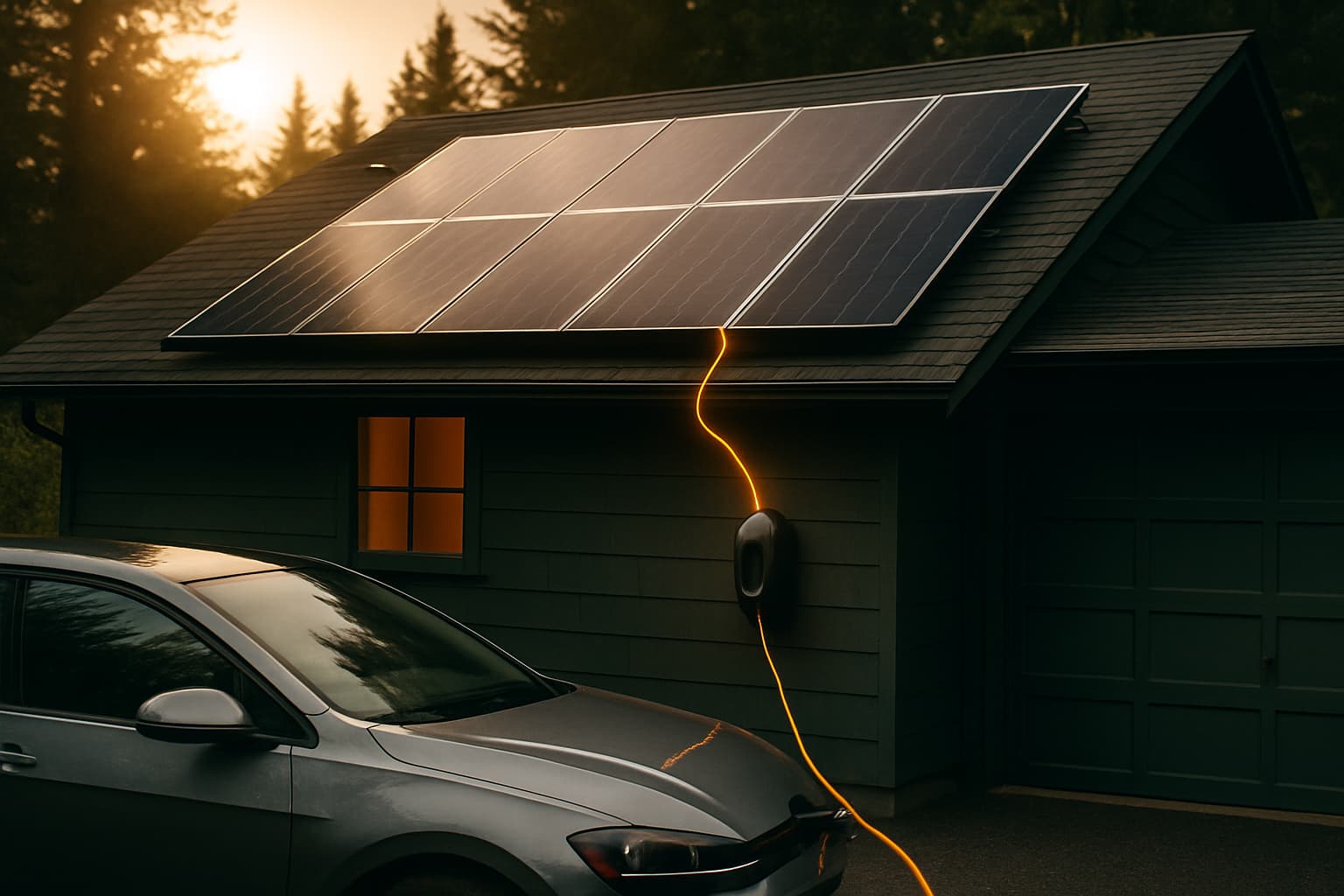
Solar + EV: The Complete Guide to Charging Your Car with Sunshine
How to power your electric vehicle with solar panels. System sizing, costs, savings, and why this combo is the ultimate money-saving setup.
Solar panels on your roof. An electric car in your garage. Together, they're the ultimate money-saving combination: free fuel from sunshine.
If you're considering an EV, solar, or both—here's making them work together.
The Math That Changes Everything
Let's run some numbers:
Gas car (30 MPG, 12,000 miles/year):
- Fuel: 400 gallons × $3.50 = $1,400/year
EV charged from the grid:
- Electricity: 3,400 kWh × $0.12 = $408/year
- Savings vs. gas: $992/year
EV charged from solar:
- Electricity: $0/year
- Savings vs. gas: $1,400/year
Over 10 years, that's $14,000 in fuel savings alone—not counting avoided gas station trips, oil changes, and the satisfaction of never supporting an oil company again.
How Much Solar Do You Need?
For the EV Alone
The average EV uses about 250-350 kWh per month (assuming 12,000 miles/year at 3.5 miles/kWh).
To produce that, you need approximately:
- 2-3 kW of solar panels (6-9 panels)
- Roof space: ~100-150 sq ft
- Cost: $5,000-8,000 before incentives
For EV + Home
Most homes use 800-1,200 kWh/month. Add EV charging, and you're looking at:
- 6-10 kW of solar panels (18-30 panels)
- Roof space: ~300-500 sq ft
- Cost: $15,000-25,000 before incentives
Right-Sizing Tip
Size your system for your total usage (home + EV). Going solar for your home alone and adding EV later means a second installation—more expensive than doing it all at once.
The Economics
Here's a realistic breakdown for a Portland-area home with an EV:
| Item | Cost | |------|------| | 8 kW solar system | $20,000 | | Federal solar incentive (expired, but leasing/PPA may still offer savings) | Varies | | Oregon rebate | -$5,000 | | Net cost | $9,000 |
Annual savings:
- Home electricity (~$1,200)
- EV charging (~$500)
- Total: $1,700/year
Payback period:
- Purchased system: ~7-9 years (federal tax credits expired in 2025)
- Leased/PPA system: ~5-6 years (solar company can still claim federal credits and pass savings to you)
Then you have 20+ years of free electricity for both your home and your car.
Do You Need a Battery?
Short answer: No, but it helps.
Without a Battery
- Solar produces during the day
- You charge your EV at night
- Net metering bridges the gap: credits during day, use at night
- Works great in Oregon/Washington (good net metering policies)
With a Battery
- Store solar power for nighttime use
- Charge EV directly from stored solar
- Backup power during outages
- Less reliance on the grid
Cost: Batteries add $8,000-15,000 to your system.
Our take: If your main goal is savings, skip the battery—net metering gives you most of the benefit. If you want outage protection or maximum independence, add the battery.
Smart Charging: Maximize Your Solar
Even without a battery, you can optimize when your EV charges:
Strategy 1: Daytime Charging (If Home)
If you work from home or have a flexible schedule, charge during peak solar production (10am-3pm). Your car pulls directly from the panels.
Strategy 2: Scheduled Charging
Most EVs and chargers let you schedule charging. Options:
- Late morning (solar production starting, rates low)
- Off-peak night (lowest utility rates)
- Time-of-use optimization (app manages automatically)
Strategy 3: Let Net Metering Handle It
Don't overthink it. Charge when convenient, let net metering balance the books. You'll come out even over the year.
Smart Charger Recommendation
The ChargePoint Home Flex lets you schedule charging around solar production or utility rates. Worth the premium if you want to optimize.
Incentive Stacking
Here's where it gets exciting. You can stack multiple incentives:
Federal
- Federal solar incentive: The 30% federal solar tax credit expired in 2025. However, if you lease your system or enter a power purchase agreement (PPA), the solar company can still claim up to 30% under Section 48E through 2027 and pass those savings to you through lower monthly payments.
- Federal EV incentive: The $7,500 federal EV tax credit expired in 2025. However, leasing an EV may still offer savings, as dealers can claim commercial credits and pass them through as lower lease payments.
Oregon
- Solar rebate: Up to $5,000
- Battery rebate: Up to $2,500
- EV rebates: Various programs, check ODOE
Washington
- No sales tax on EVs (on first $15,000)
- Utility rebates: Vary by provider
Full Stack Example
| Incentive | Amount | |-----------|--------| | EV purchase price | $45,000 | | Federal EV incentive (expired, but leasing may still offer savings) | Varies | | Solar system | $20,000 | | Federal solar incentive (leasing/PPA may still offer savings) | Varies | | Oregon solar rebate | -$5,000 | | Battery | $10,000 | | Oregon battery rebate | -$2,500 | | Total cost | $54,000 | | Total incentives | $21,000 | | Net cost | $33,000 |
And then your fuel costs drop to basically $0.
V2H and V2G: The Future
Some EVs can now send power back to your home (V2H) or the grid (V2G):
Current vehicles with V2H:
- Ford F-150 Lightning (9.6 kW output!)
- Hyundai Ioniq 5/6
- Kia EV6
- Rivian R1T/R1S
Why it matters:
- Your EV becomes a giant battery
- Power your home during outages
- Avoid paying for a separate home battery
The F-150 Lightning, for example, has a 131 kWh battery. That's enough to power an average home for 3-4 days.
Planning Ahead
If you're buying an EV and planning solar, consider a V2H-capable vehicle. It might save you $10,000+ on a home battery.
Installation Order
If getting both solar and an EV charger, install in this order:
- Solar first — the tax credit is based on installation date
- EV charger circuit at the same time — cheaper to combine electrical work
- Battery later (optional) — prices are still dropping
Why this order:
- Solar has a time-sensitive tax credit
- Combining electrical work saves $300-500
- EV charger is quick and cheap to add
- Batteries can wait—they keep getting better and cheaper
Common Questions
Q: Can I charge my EV from solar during a power outage? A: Only if you have a battery. Without one, your solar system shuts off during outages (safety requirement).
Q: How many miles can I drive on one solar panel? A: One 400W panel produces ~500 kWh/year in the PNW, which powers ~1,750 miles of driving.
Q: Should I wait for solar prices to drop? A: Prices have stabilized, and you're losing savings every month you wait. The 30% federal tax credit expired in 2025, but leasing or a PPA can still provide savings through Section 48E.
Q: What if I don't have a garage? A: Outdoor chargers work fine. Look for weatherproof units like the Grizzl-E.
Getting Started
Ready to power your EV with sunshine? Here's the process:
- Get solar quotes — compare 3+ installers
- Size for EV — tell them you have (or plan to get) an EV
- Add charger circuit — do it during solar installation
- Choose your charger — install after solar is running
- Enjoy free fuel — forever
Ready to Go Solar?
Get free quotes from top-rated local installers in Oregon & Washington.
Get My Free QuotesThe Bottom Line
Solar + EV is the ultimate combo for anyone who drives:
- No more gas bills (ever)
- No more electric bills (or minimal)
- Drive on sunshine (free fuel)
- Energy independence (with battery)
- Great for the planet (zero emissions)
The math works. The technology works. The only question is when you'll make the switch.