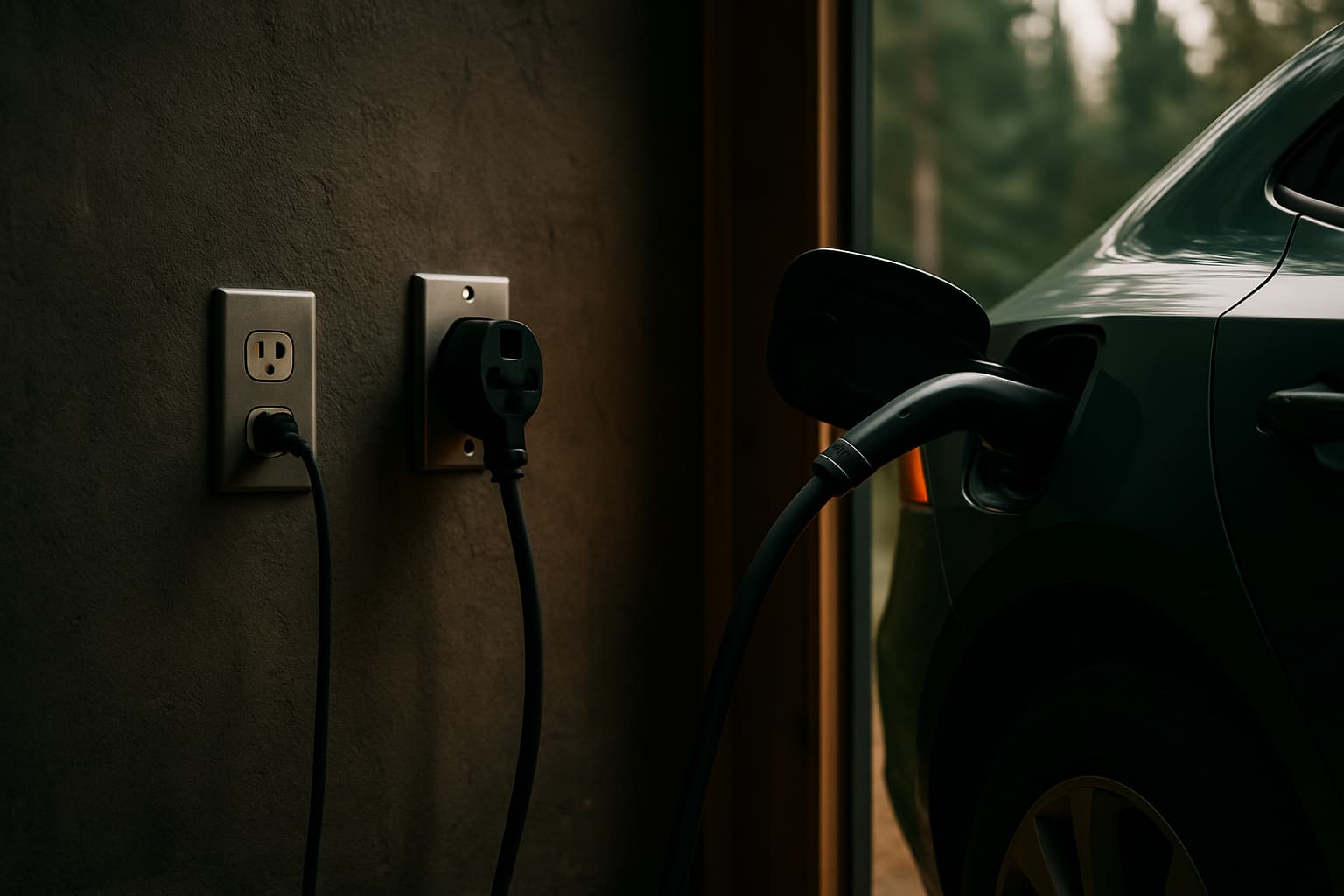
Level 1 vs Level 2 EV Charging: Which Do You Actually Need?
Level 1 vs Level 2 EV charging: Compare speed, cost, and use cases for 2026. Find out which charger is right for your Oregon home and daily driving needs.
Level 1 vs Level 2 EV Charging: Which Do You Actually Need?
You’re standing in your garage, staring at the 120V outlet that came with your EV. It works, but 3–5 miles of range per hour feels painfully slow. Meanwhile, your neighbor’s Level 2 charger adds 30 miles per hour—enough to fully recharge overnight.
Here’s the real decision you need to make: Is the convenience of faster charging worth the upfront cost?
What Are Level 1 and Level 2 Charging?
Level 1 Charging
- Voltage: 120V (standard household outlet)
- Charging Speed: 3-5 miles of range per hour
- Cable: Comes with your EV (no extra equipment needed)
- Cost: Free (included with your EV)
How it works: Level 1 charging uses the same type of outlet you'd use for a lamp or phone charger. Just plug your EV's charging cable into a standard 120V outlet, and you're good to go. No installation or extra equipment is required.
Level 2 Charging
- Voltage: 240V (like a dryer or oven outlet)
- Charging Speed: 25-40 miles of range per hour
- Cable: Requires a dedicated Level 2 charger (sold separately)
- Cost: $400-$1,200 (charger + installation)
How it works: Level 2 charging requires a dedicated 240V circuit and a Level 2 charger. This is the same type of outlet used for large appliances like dryers or ovens. Most EV owners hire an electrician to install a new circuit and outlet, and then mount the Level 2 charger in their garage or driveway.
Charging Speed: How Fast Do They Really Charge?
| Charging Level | Miles of Range per Hour | Time to Charge 200 Miles of Range | |----------------|-------------------------|-----------------------------------| | Level 1 | 3-5 miles | 40-67 hours | | Level 2 | 25-40 miles | 5-8 hours |
Level 1 Charging
- Best for: Plug-in hybrid owners, low-mileage drivers, or those who can charge overnight for 12+ hours.
- Real-world example: If you drive 30 miles a day, Level 1 charging can fully recharge your battery overnight (8-10 hours).
Level 2 Charging
- Best for: Battery-electric vehicle (BEV) owners, high-mileage drivers, or anyone who wants faster charging at home.
- Real-world example: If you drive 60 miles a day, Level 2 charging can fully recharge your battery in just 2-3 hours.
Winner: Level 2 for speed and convenience, especially for BEV owners.
Cost Comparison: Level 1 vs Level 2
Level 1 Charging
- Equipment Cost: $0 (cable included with your EV)
- Installation Cost: $0 (uses existing outlets)
- Electricity Cost: ~$0.14 per kWh (average residential rate in Oregon)
- Annual Cost (30 miles/day): ~$300-$400
Level 2 Charging
- Equipment Cost: $400-$700 (charger)
- Installation Cost: $500-$1,200 (varies by electrician and panel upgrades)
- Electricity Cost: ~$0.14 per kWh (same as Level 1, but you'll use more power for faster charging)
- Annual Cost (30 miles/day): ~$300-$400 (same as Level 1, but you'll charge faster)
Winner: Level 1 for upfront cost, Level 2 for long-term convenience and speed.
Installation: What's Involved?
Level 1 Charging
- No installation required. Just plug your EV's charging cable into a standard 120V outlet.
- Best for: Renters, apartment dwellers, or anyone who can't (or doesn't want to) modify their home's electrical system.
Level 2 Charging
- Requires a dedicated 240V circuit and outlet. Most EV owners hire an electrician to install a new circuit and mount the charger.
- Installation time: 2-4 hours (for a straightforward job)
- Panel upgrades: If your electrical panel is full or outdated, you may need an upgrade ($1,000-$3,000).
- Best for: Homeowners with a garage or driveway, or anyone who wants faster charging at home.
Winner: Level 1 for simplicity, Level 2 for homeowners who want faster charging.
Use Cases: Which Charger Is Right for You?
Choose Level 1 Charging If:
- You drive less than 40 miles per day.
- You own a plug-in hybrid (PHEV) with a small battery.
- You rent your home or can't install a Level 2 charger.
- You don't want to spend money on equipment or installation.
- You can charge overnight for 12+ hours.
Choose Level 2 Charging If:
- You drive more than 40 miles per day.
- You own a battery-electric vehicle (BEV) with a large battery.
- You want faster charging (e.g., top up your battery in a few hours).
- You own your home and can install a dedicated circuit.
- You want to take advantage of Time-of-Use (TOU) rates (cheaper electricity at night).
- You plan to own your EV for several years (long-term convenience).
Time-of-Use (TOU) Rates: Save Money with Level 2
Many utilities in Oregon (like Portland General Electric and Pacific Power) offer Time-of-Use (TOU) rates, which make electricity cheaper at night. If you have a Level 2 charger, you can schedule charging sessions for off-peak hours and save money on your electricity bill.
- Level 1: Not ideal for TOU rates (slow charging means you'll use more electricity during peak hours).
- Level 2: Perfect for TOU rates (fast charging means you can fully charge your battery during off-peak hours).
Winner: Level 2 for TOU savings.
Real-World Scenarios: Which Charger Fits Your Lifestyle?
Scenario 1: The Commuter
- Drives: 50 miles per day
- Vehicle: Tesla Model 3 (BEV)
- Home: Owns a house with a garage
- Best Choice: Level 2 (fast charging, TOU savings, long-term convenience)
Scenario 2: The Weekend Driver
- Drives: 20 miles per day (mostly on weekends)
- Vehicle: Toyota RAV4 Prime (PHEV)
- Home: Rents an apartment
- Best Choice: Level 1 (no installation, low upfront cost, enough range for daily driving)
Scenario 3: The Road Tripper
- Drives: 30 miles per day (but takes frequent road trips)
- Vehicle: Ford F-150 Lightning (BEV)
- Home: Owns a house with a driveway
- Best Choice: Level 2 (fast charging for road trip prep, TOU savings)
Scenario 4: The Budget-Conscious Buyer
- Drives: 25 miles per day
- Vehicle: Chevrolet Bolt (BEV)
- Home: Owns a house but wants to minimize costs
- Best Choice: Level 1 (if you can charge overnight) or Level 2 (if you want faster charging and TOU savings)
Pros and Cons: Level 1 vs Level 2
Level 1 Charging
Pros:
- No upfront cost (cable included with your EV)
- No installation required (uses standard outlets)
- Great for PHEVs and low-mileage drivers
- Portable (take it with you when you travel)
Cons:
- Slow charging (3-5 miles of range per hour)
- Not ideal for BEVs or high-mileage drivers
- No smart features (can't schedule charging or monitor energy use)
Level 2 Charging
Pros:
- Fast charging (25-40 miles of range per hour)
- Great for BEVs and high-mileage drivers
- Smart features (scheduling, energy monitoring, TOU optimization)
- Long-term convenience (faster charging, better for road trips)
Cons:
- Upfront cost ($400-$1,200 for charger + installation)
- Requires installation (dedicated 240V circuit)
- Not portable (fixed installation)
Bottom Line
So, which charger do you actually need? Here's the breakdown:
Choose Level 1 Charging If:
- You drive less than 40 miles per day.
- You own a plug-in hybrid (PHEV) with a small battery.
- You rent your home or can't install a Level 2 charger.
- You don't want to spend money on equipment or installation.
- You can charge overnight for 12+ hours.
Choose Level 2 Charging If:
- You drive more than 40 miles per day.
- You own a battery-electric vehicle (BEV) with a large battery.
- You want faster charging (e.g., top up your battery in a few hours).
- You own your home and can install a dedicated circuit.
- You want to take advantage of Time-of-Use (TOU) rates.
- You plan to own your EV for several years (long-term convenience).
Final Tip:
If you're still unsure, start with Level 1 charging and see if it meets your needs. If you find yourself wishing for faster charging, you can always upgrade to Level 2 later. Many EV owners start with Level 1 and switch to Level 2 as their driving habits or vehicle needs change.
For most Oregon EV owners, Level 2 charging is the best long-term investment-especially if you drive a BEV or want the convenience of faster charging at home.