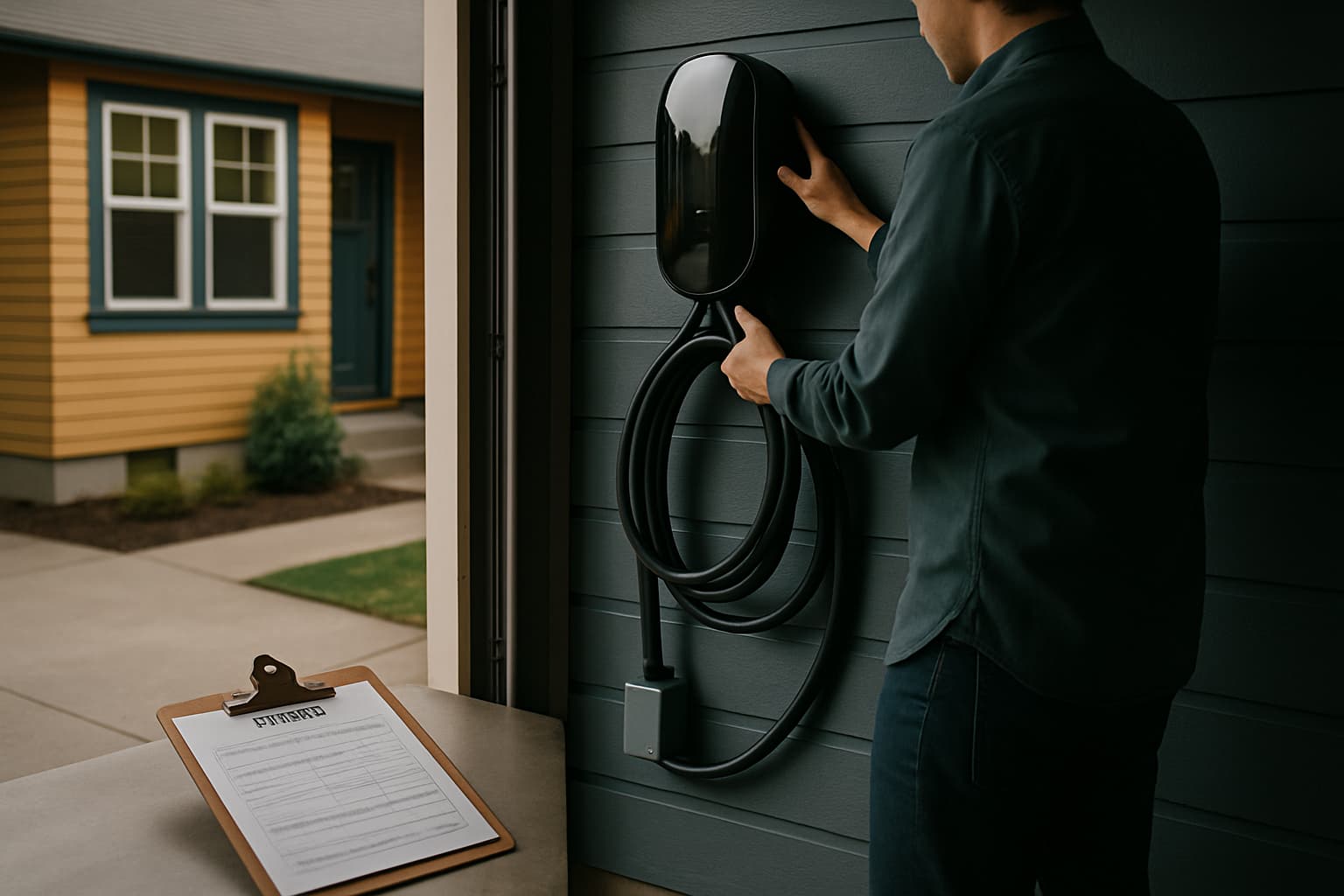
How to Set Up Home EV Charging: Electrician, Permits & Costs
A step-by-step guide to setting up home EV charging in Oregon, including electrician requirements, permits, costs, and Portland-specific rules for 2026.
How to Set Up Home EV Charging: Electrician, Permits & Costs
Your new EV sits in the driveway, and the included Level 1 charger is plugged into a standard outlet. It adds 3–5 miles of range per hour—fine for overnight top-ups, but if you drive more than 30 miles a day, you’ll spend 12+ hours charging just to keep up.
Here’s how to upgrade to a Level 2 charger, cut charging time to 2–3 hours, and avoid the public charging scramble.
Why Set Up Home EV Charging?
Convenience
- Wake up to a full battery every day—no more detours to public chargers.
- Charge overnight when electricity rates are lowest.
Cost Savings
- Home electricity is cheaper than public charging (and often cheaper than gas).
- Oregon offers rebates for home charging equipment and installation.
Faster Charging
- Level 2 chargers (240V) add 25-40 miles of range per hour—much faster than a standard outlet.
Increase Home Value
- Home EV charging is a selling point for future buyers.
Step 1: Assess Your Electrical Panel
Before installing a Level 2 charger, you need to check if your electrical panel can handle the load. Here’s how:
Find Your Electrical Panel
- Most panels are located in garages, basements, or utility rooms.
- Look for a metal box with circuit breakers inside.
Check Your Panel’s Capacity
- Most homes have 100-200 amp panels.
- Level 2 chargers require 30-50 amps (depending on the charger).
- Rule of thumb: Your panel should have at least 20% spare capacity for a Level 2 charger.
Hire an Electrician for a Load Calculation
- An electrician will calculate your home’s electrical load to ensure your panel can handle the charger.
- If your panel is full or outdated, you may need a panel upgrade.
Cost of Panel Upgrade (2026):
- $1,500 - $3,500 (depending on complexity and local labor rates).
Step 2: Choose the Right EV Charger
Not all EV chargers are created equal. Here’s what to consider:
Level 1 vs. Level 2 Chargers
| Feature | Level 1 Charger (120V) | Level 2 Charger (240V) | |------------------------|-----------------------------|-----------------------------| | Charging Speed | 3-5 miles of range per hour | 25-40 miles of range per hour | | Installation | Plugs into standard outlet | Requires 240V circuit | | Cost | $0 (included with EV) | $400 - $1,200 | | Best For | Plug-in hybrids, low-mileage drivers | Full EVs, daily charging |
Recommendation: Install a Level 2 charger for the best experience.
Top Level 2 Chargers for 2026
| Charger Model | Max Power (kW) | Wi-Fi/Bluetooth | Smart Features | Price (2026) | |-----------------------|----------------|-----------------|------------------------------|--------------| | Tesla Wall Connector | 11.5 | Yes | Tesla app integration | $550 | | ChargePoint Home Flex | 12 | Yes | Alexa, scheduling, energy tracking | $650 | | JuiceBox 40 | 9.6 | Yes | App control, voice assistant | $600 | | Emporia EV Charger | 11.5 | Yes | Energy monitoring, solar integration | $400 | | Wallbox Pulsar Plus | 7.4 | Yes | Load balancing, solar ready | $650 |
Recommendation:
- Best Overall: ChargePoint Home Flex (reliable, smart features).
- Best Budget: Emporia EV Charger (great value).
- Best for Tesla Owners: Tesla Wall Connector (seamless integration).
Hardwired vs. Plug-In Chargers
- Hardwired: More permanent, slightly safer, and often required for outdoor installations.
- Plug-In: Easier to remove or replace, but requires a NEMA 14-50 or 6-50 outlet.
Recommendation: Hardwire your charger for a cleaner, more permanent setup.
Step 3: Hire a Licensed Electrician
Do not attempt to install a Level 2 charger yourself. Hiring a licensed electrician ensures:
- Safety: Proper wiring and grounding to prevent fires or electrical hazards.
- Code Compliance: Meets Oregon and local building codes.
- Permit Approval: Required for most installations in Oregon.
How to Find a Qualified Electrician
- Ask for Recommendations: Check with EV owners, local Facebook groups, or Nextdoor.
- Search Online: Use Google, Yelp, or Angi to find electricians with EV charging experience.
- Check Licenses: Verify the electrician is licensed in Oregon (Oregon CCB).
- Get Multiple Quotes: Aim for at least 3 quotes to compare pricing.
Questions to Ask Your Electrician
- Do you have experience installing EV chargers?
- Will you pull the necessary permits?
- Do I need a panel upgrade?
- What’s the total cost, including labor and materials?
- How long will the installation take?
Cost of Electrician Installation (2026):
- $500 - $2,000 (depending on complexity, distance from panel, and labor rates).
Step 4: Pull Permits (Oregon & Portland Requirements)
Do You Need a Permit?
- Yes, in most cases. Oregon requires permits for new 240V circuits (Level 2 chargers).
- Portland: The City of Portland requires a electrical permit for all Level 2 charger installations.
How to Pull a Permit
- Your electrician will typically handle this, but you can also apply yourself:
- Oregon (outside Portland): Oregon Building Codes Division (BCD)
- Portland: Portland Permitting & Development
- Cost: $50 - $200 (varies by jurisdiction).
Inspection Process
- After installation, a city or county inspector will visit to verify code compliance.
- Your electrician will schedule this—don’t skip it!
Step 5: Install the Charger
Once permits are pulled and your electrician is ready, here’s what to expect:
Installation Day
- Time Required: 4-8 hours (depending on complexity).
- What Happens:
- The electrician runs a new 240V circuit from your panel to the charger location.
- They install a dedicated breaker for the charger.
- The charger is mounted and wired (hardwired or plugged into a NEMA outlet).
- The system is tested to ensure it works safely.
Where to Install the Charger
- Garage: Most common, protected from weather.
- Driveway: Use a weatherproof charger and conduit for wiring.
- Carport: Similar to garage installation, but may require additional weatherproofing.
Pro Tip: Install the charger close to where you park to minimize cable length.
Weatherproofing (Outdoor Installations)
- Use a NEMA 3R or NEMA 4-rated charger for outdoor use.
- Conduit: Protect wiring with metal or PVC conduit.
- Grounding: Ensure proper grounding to prevent electrical hazards.
Step 6: Claim Oregon Rebates and Incentives
Oregon offers several rebates and incentives to offset the cost of home EV charging:
Oregon Clean Vehicle Rebate Program (OCVRP) - Charging Equipment
- Up to $500 for home charging equipment (income limits apply).
- Income Limits (2026):
| Household Size | Maximum Annual Income | |----------------|------------------------| | 1 | $51,520 | | 2 | $69,680 | | 3 | $87,840 | | 4 | $106,000 | | 5+ | Add $18,160 per person |
Federal Tax Credit (2026)
- The federal EV charger credit (Section 30C) is phasing out by mid-2026 — check current eligibility. If still available, it covers 30% of charging equipment and installation costs (up to $1,000).
- Form: IRS Form 8911.
Local Utility Rebates
- Portland General Electric (PGE): Up to $500 for Level 2 chargers.
- Pacific Power: Up to $1,000 for Level 2 chargers.
How to Claim Rebates:
- Keep receipts for equipment and installation.
- Apply online through the OCVRP portal (oregon.gov/deq).
- Submit IRS Form 8911 with your federal tax return.
Step 7: Maintain Your Charger
Regular Cleaning
- Wipe down the charger with a damp cloth to remove dust and debris.
- Check the cable for wear and tear.
Software Updates
- Smart chargers (e.g., ChargePoint, JuiceBox) may require firmware updates.
- Check the manufacturer’s app for updates.
Troubleshooting
- Charger not turning on? Check your circuit breaker.
- Slow charging? Ensure the charger is set to the correct amperage.
- Error messages? Consult the user manual or manufacturer’s support.
Cost Breakdown for Home EV Charging Setup (2026)
| Expense | Estimated Cost (2026) | |--------------------------|-----------------------| | Level 2 Charger | $400 - $1,200 | | Electrical Panel Upgrade | $1,500 - $3,500 | | Electrician Labor | $500 - $2,000 | | Permits | $50 - $200 | | Weatherproofing (Outdoor) | $100 - $500 | | Total (Basic Setup) | $1,050 - $3,900 | | Total (Panel Upgrade) | $2,550 - $7,400 |
After Rebates (Estimate):
- $500 - $2,000 (depending on eligibility and incentives).
Portland-Specific Requirements
Portland has additional rules for home EV charging:
Electrical Permit
- Required for all Level 2 charger installations.
- Apply through Portland Permitting & Development.
ADU (Accessory Dwelling Unit) Rules
- If you’re installing a charger for an ADU, you may need additional permits.
- Check with the City of Portland for specific requirements.
Historic Districts
- If your home is in a historic district, you may need approval from the Historic Landmarks Commission.
Bottom Line
- Home EV charging is a game-changer—convenient, cost-effective, and faster than public charging.
- Steps to set up: Assess your panel choose a charger hire an electrician pull permits install claim rebates.
- Cost: $1,000 - $7,000 (before rebates), but Oregon incentives can cut this in half.
- Portland requirements: Electrical permit, ADU rules, and historic district approvals may apply.
- Best chargers for 2026: ChargePoint Home Flex (best overall), Emporia EV Charger (best budget), Tesla Wall Connector (best for Tesla owners).
Don’t wait—start planning your home EV charging setup today and enjoy the convenience of waking up to a full battery every morning!